
The complete guide
H4 LED Headlight Bulbs, A Practical Buyer's Guide
The problem most people are actually trying to solve
Almost nobody shops for bulbs because bulbs are interesting. They shop because something is bugging them. The light coming out of a project car looks tired and yellow next to everything else in the driveway. A trail truck gets used at dusk on private land and the owner wants a cleaner-looking light. A show build has fresh paint, new wheels, new grille, and then two dull orange-ish headlights ruining the front end in photos.
That is where an H4 LED conversion kit usually enters the picture. The H4 base is one of the most common headlight fittings there is, which is why there are so many options for it, and why it is worth taking a minute to understand what you are actually choosing between.
Before we go further, the important bit. In Canada, putting LED bulbs into headlight housings that were built around halogen bulbs is generally not permitted on public roads. This set is sold for off-road, show and private property use. That is not a loophole or a technicality to work around, it is the condition of sale, and it should shape whether this product belongs in your build at all.
What H4 actually means
H4 describes the physical base of the bulb. The shape of the flange, the position of the tabs, the plug on the back. If your lamp takes an H4 bulb, an H4 bulb will locate in it.
You will also see the same base written as 9003 or HB2. Different catalogues, different regions, same fitting. North American parts listings lean toward 9003 and HB2, European listings lean toward H4. If the bulb you pull out of your lamp has any of those three codes stamped on it, you are looking at the same base.
What H4 does not tell you is whether the bulb will physically clear whatever sits behind your headlight housing. That varies enormously. Some vehicles have fist-sized gaps behind the lamp, others have an airbox or a washer bottle sitting almost against the dust cap. Check your own space before ordering.
Colour temperature, in plain language
This pair is 6000K. The K stands for Kelvin and it is a measurement of colour, not of quantity.
Lower numbers lean warm and yellow. A standard halogen bulb sits down in that warmer range, which is why halogen light has that slightly amber cast. Climb the scale and the light shifts toward neutral white and then toward a cooler white with a faint blue edge. At 6000K you are in that cool white territory.
Whether you like it is a taste question. On a clean show build, cool white tends to suit modern paint and chrome. Some people find warmer light easier on the eyes. Neither is objectively correct, and the number on the box tells you about tone, nothing more.
Fanless, and why some people care
Open up the back end of a lot of LED conversion bulbs and you will find a tiny fan. Its job is to move heat away from the LED chips. Fans work, but they bring a few trade-offs. They make noise, which you can sometimes hear at idle with the hood up or through a thin firewall. They draw in air, which means they can draw in dust. And they are a moving part in a sealed-ish space.
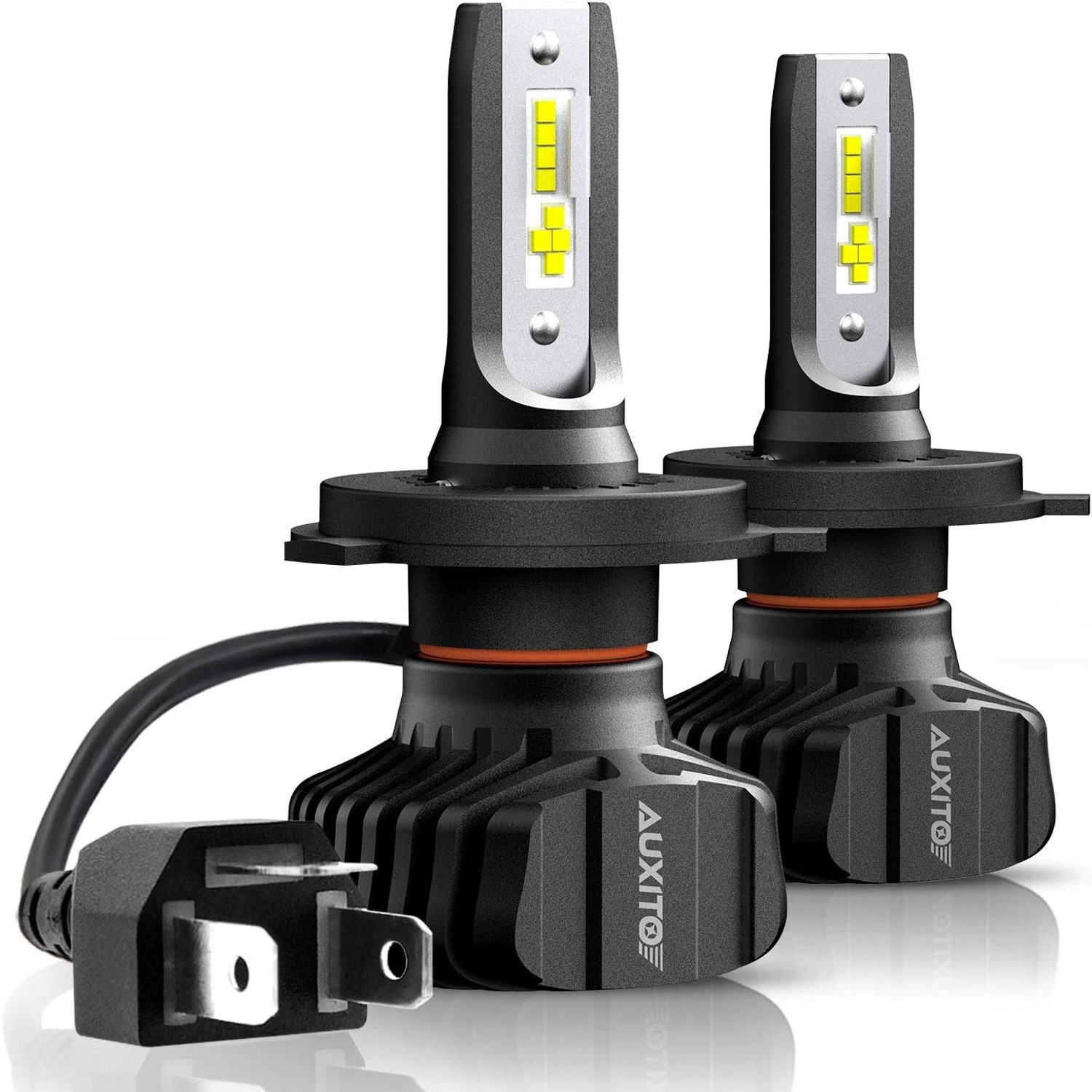
A fanless bulb takes a different approach and relies on the body of the bulb to carry heat away instead. The benefit is simple. Nothing spins, nothing whirs, nothing to clog. For anyone chasing the best fanless led headlight bulbs for a quiet build, that is usually the whole appeal.
The trade is that a fanless bulb depends on having somewhere for heat to go. A sealed dust cap packed tight against the back of the bulb is not ideal for any conversion bulb. Give it room where you can.
The IP67 rating
IP67 is an ingress protection figure. The first digit covers solid things like dust, the second covers water.
For a sealed factory housing in a daily driver, that rating matters less, because the housing does most of the protecting. It matters more on an off-road build where the housing has been opened, swapped, drilled for wiring, or simply cracked and resealed a few times. In that world, grit and spray get to places they should not, and the best ip67 led bulbs earn their keep.
The dash warning and the flicker question
Here is the thing that catches people out. On some vehicles, you fit LED bulbs, you start the engine, and a bulb-out warning lights up the dash. Or the headlights flicker. Or both.
This is not usually a faulty bulb. Some vehicles watch the headlight circuit and expect it to behave the way a halogen bulb behaves. When it does not, the vehicle reports a problem.
The usual answer is a CANbus decoder, a small module that sits in line and smooths that difference out. One is not included with this set, so if your vehicle turns out to be one of the fussy ones, you will need to buy a decoder separately. Worth knowing in advance rather than discovering it at ten at night in a cold garage.
Who this pair suits
It suits someone with an off-road vehicle used on private land or trails, who wants a cooler white light and does not want fan noise. It suits a show build where the front end gets photographed and the owner wants the lights to match the rest of the work. It suits anyone collecting parts for a project that is not registered for road use.
It does not suit someone looking for a road-legal headlight upgrade for a daily driver in Canada. If that is your goal, this is the wrong product, and we would rather say so here than have you find out after the box arrives.
How to choose well
Start with the code on your current bulb. Pull it, read it, write it down. H4, 9003 or HB2 means the base matches.
Then measure. Hold a tape to the space behind your headlight housing and note what you have. Clearance problems are the single most common reason a conversion kit ends up back in the box.
Then think about colour. If the rest of your build runs cool white lighting, 6000K will sit nicely with it. If you have warmer accessory lights, consider whether you want a mismatch across the front of the vehicle.
Finally, budget for the possibility of a decoder. Not every vehicle needs one, but if yours does, it is a small extra cost rather than a dealbreaker.
Fitting and looking after them
Most installs follow the same pattern. Pop the dust cap, release the retaining clip or twist collar, unplug the old bulb, fit the new one, reconnect, replace the cap. Some vehicles need the airbox or a wheel arch liner moved first. If access looks nasty, a shop will do it in very little time.
Handle the bulbs by the base rather than the light-emitting area. Keep fingerprints off where you can. Make sure the connector is clean and dry before plugging in.
After that, maintenance is mostly leaving them alone. Wipe dust off with a dry, lint-free cloth. Let a bulb cool before you remove it. Keep spare bulbs in their box, somewhere dry and not under a toolbox.
The short version
Two H4 LED bulbs, sold as a pair. 6000K cool white colour. Fanless body, so no fan noise. IP67 rated against dust and water. Some vehicles will throw a bulb warning or flicker and may need a CANbus decoder, which is not in the box.
And the part that decides it for most people. This is an LED conversion bulb, and in Canada fitting LED bulbs into halogen headlight housings is generally not permitted on public roads. Buy this pair for an off-road machine, a show car or a private property vehicle, and it makes sense. Buy it for a road car and it does not.